
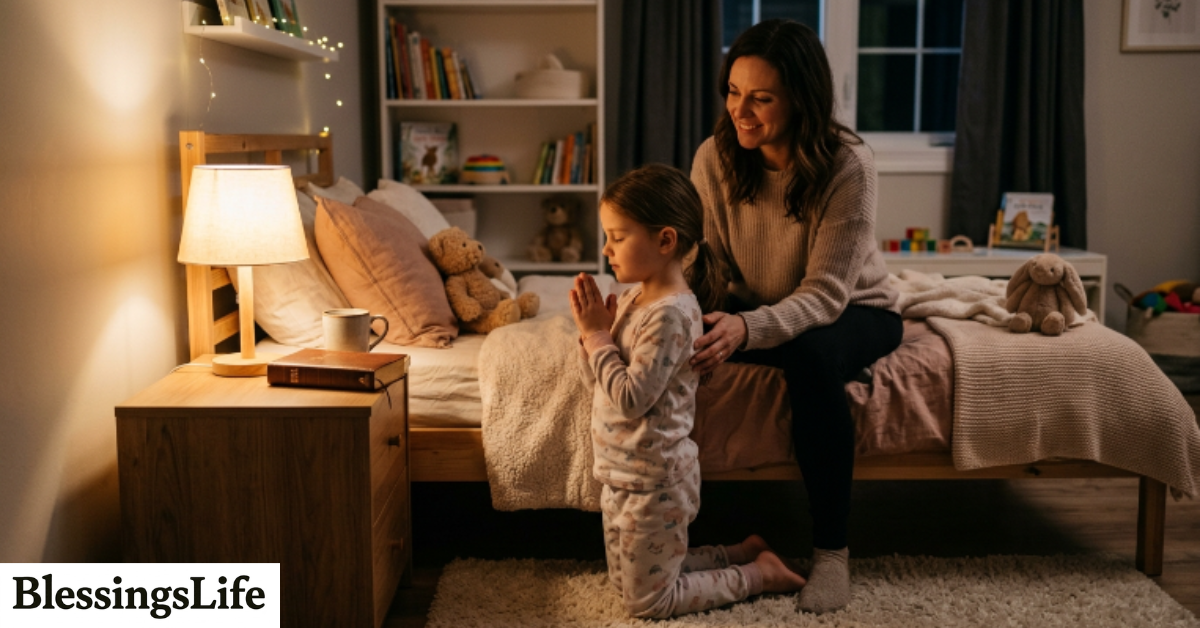
It’s 8:47 p.m. The bath is done, the pajamas are on (inside out, but on), and your little one is asking for one more glass of water. Again.
Every parent knows this window. It’s the softest part of the day and also the most chaotic. Somewhere in that mess, a quiet moment is waiting for you, and a night prayer for kids is one of the simplest ways to claim it.
You don’t need perfect words. You don’t need a religious degree. You need about sixty seconds, a dim light, and a child who feels safe. Let’s talk about how to make that happen.
Why a Night Prayer for Kids Matters More Than You Think
A few years ago, a mother told me about her five-year-old son, who had terrible trouble falling asleep. He’d lie there with wide eyes, listing every worry a small mind can hold: the dark, the noise in the hallway, whether his grandmother was okay.
She started sitting on the edge of his bed and saying a short prayer with him. Nothing fancy. Just “thank you for today, keep us safe tonight.” Within two weeks, he was asking for it before she could even turn off the lamp.
That’s the real power here. A bedtime prayer isn’t only about faith, though for many families it’s deeply that. It’s also about:
- Emotional safety. Children hear that someone is watching over them.
- Routine. Predictable rituals tell a child’s body it’s time to slow down.
- Gratitude. Ending the day with “thank you” trains a mind to notice good things.
- Connection. Those sixty seconds may be the only time all day your child has your undivided attention.
Kids don’t remember most of what we say to them. They do remember how bedtime felt.
What Makes a Good Bedtime Prayer for Children?
Here’s a secret: the best prayers for little ones are almost boringly simple.
Think about what a young child can actually hold in their head. A three-year-old can’t follow a paragraph of formal language. They can follow “Thank you for my family. Please keep us safe. Goodnight.”
A good night prayer for kids usually has these qualities:
- It’s short. Four to eight lines is plenty for most children.
- It uses their language. If words like “protect” or “sanctuary” go over their head, swap them for “keep” and “safe.”
- It rhymes or repeats (optional but helpful). Rhythm sticks in a child’s memory.
- It ends in peace. The last line should feel like a deep breath.
- It’s said gently. Your tone matters more than the wording.
If you ever feel like you’re doing it wrong, remember this. God, or whoever you pray to, isn’t grading vocabulary.
Simple Night Prayers for Toddlers and Preschoolers (Ages 2-5)

Little ones love repetition, so pick one prayer and stay with it for a while. Here are a few you can use or adapt.
The “Thank You” Prayer
Thank you for the sun today,
Thank you for the time to play.
Thank you for the ones I love,
Watch me from the sky above.
Goodnight.
The “Keep Us Safe” Prayer
Dear God, the day is done,
Thank you for the fun.
Keep me safe until the light,
Hold my family close tonight.
Amen.
The Classic Rhyme
Many of us grew up with the old bedtime rhyme that begins “Now I lay me down to sleep.” It’s been passed down for centuries and is in the public domain, so you’re free to use it as it is. For some families that little verse carries a whole childhood of memories, and that’s worth something.
If it feels a bit heavy for your child, you can always soften or update the wording. Traditions grow when we let them.
Bedtime Prayers for Early Readers (Ages 6-9)
Somewhere around first or second grade, kids start asking bigger questions. Why do people get sick? What happens when we die? Why did my friend say something mean?
Their prayers can grow with them. At this age, try adding a reflection moment, where your child can name one thing they’re thankful for and one thing that’s worrying them.
A Prayer for a Hard Day
God, today was tricky, and you know it.
Thank you for staying close to me.
Help me forgive the things that hurt.
Help me sleep, and help tomorrow be gentler.
Amen.
A Prayer for Worry
When my mind is loud and busy,
Help it slow and rest.
I give my worries to you tonight,
Because you know what’s best.
Amen.
A story from a dad I know: his daughter came home from school in tears about a friendship falling apart. At bedtime, instead of fixing it, he simply said, “Do you want to tell God about it?” She whispered the whole thing into the dark. He said he’d never seen her shoulders drop so fast.
Sometimes the prayer is just permission to say it out loud.
Night Prayers for Older Kids and Tweens (Ages 10-13)
Let’s be honest: an eleven-year-old might roll their eyes at a rhyming prayer. That’s okay. It doesn’t mean the practice has to end. It just needs to grow up.
For tweens, try open-ended prayers where they choose the words. A simple frame works well:
- Thank: One thing from today.
- Sorry: One thing they’d do differently.
- Please: One thing they need help with.
That’s it. Three sentences. Some parents call it “Thank, Sorry, Please,” and kids remember it easily.
A tween-friendly example:
“Thanks for my team winning today. Sorry I snapped at my brother. Please help me not be so nervous about tomorrow’s test. Goodnight.”
Real, short, and honest. That’s what older kids respond to.
Quotes and Examples Box: Short Blessings to Whisper at Bedtime
Sometimes you don’t need a whole prayer. Sometimes a single line, whispered while you tuck the blanket in, is enough. Here are some you can borrow.
Little bedtime blessings
- “May your dreams be soft and your sleep be deep.”
- “You are loved today, tomorrow, and always.”
- “God is watching over you while you rest.”
- “Sleep well, sweet one. The morning is coming.”
- “Whatever happened today, you are safe now.”
- “May angels guard your room tonight.”
- “Rest your body. Rest your heart. You did enough today.”
Feel free to write your favorite on a card and tape it beside their bed. It’s amazing how kids treasure these little words.
Bedtime Duas for Muslim Families
If you’re raising your children in the Islamic tradition, a night dua is a beautiful part of the evening, and children pick these up quickly because they’re short and rhythmic.
Many families teach these simple practices:
- Reciting Ayat al-Kursi before sleep, often learned gradually as children grow older.
- Saying the short dua “Bismika Allahumma amutu wa ahya” (in Your name, O Allah, I die and I live), which is taught in the tradition as a sleeping supplication.
- Reciting Surah Al-Ikhlas, Al-Falaq, and An-Nas, three short surahs many children memorize early.
- Saying “Bismillah” before lying down and “Alhamdulillah” for the day that has passed.
For very young children, even “Bismillah, and thank you Allah for today” is a lovely start. If you’re unsure about pronunciation or meaning, ask your local imam or a trusted teacher to guide you. Accuracy matters, but warmth matters just as much.
How to Build a Bedtime Prayer Routine That Actually Sticks
Lots of parents start with good intentions and then watch the habit fade by Thursday. Sound familiar? Here’s how to make it stick.
Start Small (Really Small)
Don’t begin with a ten-minute devotion. Begin with thirty seconds. A tiny habit you actually do beats a big one you abandon.
Attach It to Something Already Happening
Prayer works best when it’s tied to a step in your routine. For example:
- After brushing teeth
- Right after the story
- Just before you turn off the light
When it’s part of the chain, your child anticipates it, and you stop having to remember.
Make the Space Cozy
Dim the lights. Lower your voice. Sit close. Some families keep a small lamp or a special blanket just for prayer time. The environment tells your child, “This is a calm, safe moment.”
Let Your Child Lead Sometimes
Ask, “Who do you want to pray for tonight?” Children often surprise us. One little girl I heard about always prayed for “the lonely dog next door.” Her parents never forgot it.
Don’t Force It
If your child is having a rough night, a short “goodnight, God loves you” is enough. Forced prayer can backfire. The goal is warmth, not perfection.
Turning Prayer Into a Family Moment
Bedtime doesn’t have to be a solo act. If you have more than one child, or if both parents are around, make it a shared circle.
One family I know does something they call “high, low, thank-you.” Everyone shares the best part of their day, the hardest part, and something they’re grateful for. Then someone says a short prayer to wrap it up.
It takes five minutes. It’s also the reason their teenage son still sits on the edge of his little sister’s bed some nights, because the habit built something real between them.
A night prayer for kids can become the thread that holds a family together when everything else is moving fast.
What to Do When Your Child Is Scared at Night
Fear at bedtime is normal. Monsters, storms, shadows, and the wild imaginations of children all show up after the lights go out.
Prayer can help, but it works best alongside comfort, not instead of it. Here’s a gentle approach:
- Acknowledge the fear. Say, “I hear you. That feels scary.”
- Don’t dismiss it. “There’s nothing there” rarely helps a frightened child.
- Offer a prayer for courage. Something like: “God, please be with me in the dark. Help me feel brave and know I’m not alone.”
- Use a comfort object. A stuffed animal, a nightlight, or a favorite blanket can be part of the ritual.
- Stay a few minutes. Your presence is as powerful as any words.
A mom once shared that her son called his nightlight “God’s flashlight.” They prayed over it every evening. Years later he’s a confident teenager, but he still remembers that little light.
Teaching Gratitude Through a Night Prayer for Kids
Gratitude might be the most valuable thing a child can learn, and bedtime is the perfect classroom.
When you ask, “What are you thankful for today?”, you’re training your child’s brain to scan for good things instead of only problems. Over time, that becomes a lens.
Some prompts you can use:
- “What made you laugh today?”
- “Who was kind to you?”
- “What’s one thing you’re proud of?”
- “What do you want to thank God for tonight?”
The answers are often tiny and wonderful. “The banana was good.” “My friend shared her crayons.” “I saw a bird.” Take them seriously. They’re the raw material of a grateful heart.
Prayers for Special Situations
Life doesn’t always follow a calm script. Sometimes your child needs a prayer shaped for what they’re facing.
When Someone Is Sick
God, please be with (name) tonight.
Help their body heal and their heart be brave.
Help me trust that you’re taking care of them.
Amen.
When a Loved One Has Passed Away
Children grieve differently than adults. They may ask blunt questions or seem fine and then cry an hour later. A gentle prayer might sound like:
Thank you for (name) and all the love they gave.
I miss them, and that’s okay.
Keep them safe and keep me close to those who love me.
Amen.
Before a Big Day
Tomorrow is new and I’m a little nervous.
Please stay near me and give me courage.
Help me be kind, and help me do my best.
Amen.
After a Fight or Bad Behavior
I made a mistake today and I’m sorry.
Help me do better tomorrow.
Thank you for loving me even when I mess up.
Amen.
This last one may be the most important. Children need to hear that love isn’t withdrawn when they fail. That’s a truth worth building into the end of every day.
Common Mistakes Parents Make (and Easy Fixes)
None of us get this perfectly. A few things to watch for:
- Making it too long. Sleepy kids lose focus fast. Keep it brief.
- Using it as a threat. “God is watching you be naughty” turns comfort into fear. Bedtime prayer should feel safe.
- Rushing. If you’re checking your phone during the prayer, they’ll notice.
- Giving up after a missed night. You’ll skip some evenings. Start again the next one. That’s completely fine.
- Expecting a “perfect” response. Some nights they’ll giggle, wiggle, or fall asleep mid-sentence. All of it counts.
Making It Your Own
The best prayer at your house won’t come from a website. It will come from your family’s own voice, your beliefs, and the small details of your child’s day.
Try writing a short prayer together. Let your child pick a line or a word. Maybe they want to include the cat. Maybe they insist on mentioning tomorrow’s pizza. Honor it.
Years from now, they may not remember the exact words. But they’ll remember the sound of your voice in the dark and the feeling of being held in something bigger than the day.
One Last Whisper Before the Lights Go Out
Parenting is loud. Days blur. Laundry piles up, and there’s always one more thing.
And yet, every night, you get a small doorway. A quiet minute where a child can hear that they’re loved, they’re safe, and tomorrow will come. A night prayer for kids doesn’t need to be polished or long. It just needs to be said.
So tonight, try it. Pick one prayer from this list, or make up your own. Sit close. Lower your voice. See what happens.
If this helped, share it with a parent who could use a gentle bedtime idea. And tell me in the comments: what’s the prayer your family says at night? I’d love to hear it.
Sleep well, little ones.
FAQs
What is a good night prayer for kids?
A good night prayer for kids is short, simple, and comforting. It usually thanks God for the day, asks for protection through the night, and ends with peace, such as “Thank you for today, keep me safe tonight. Amen.”
At what age should I start teaching my child a bedtime prayer?
You can begin as early as infancy, since babies respond to your calm voice and routine. By age two or three, most children can repeat a short line or two, and by four or five they can join in fully.
How long should a night prayer for kids be?
Thirty seconds to two minutes is plenty for most children. Toddlers do best with three to four short lines, while older kids can manage a longer, more personal prayer.
What if my child doesn’t want to pray at bedtime?
Don’t force it. Try changing the format: let them lead, use a favorite stuffed animal, or shorten it to one sentence. Making it warm and low-pressure usually brings them back on their own.
Can bedtime prayers help children sleep better?
Many parents find they do. A consistent, calming ritual helps a child’s body and mind wind down, and expressing worries in a prayer can ease anxiety. It’s not a cure for sleep problems, but it’s a gentle support.
Are there bedtime prayers for non-Christian families?
Yes. Muslim families often teach short duas and the last three surahs of the Quran, while other traditions have their own blessings and gratitude practices. Many families also use simple, non-denominational words of thanks and love.