
There’s a particular kind of tired that prayer books don’t always talk about. The tired that comes from waiting on an answer that hasn’t arrived yet. The tired of holding a worry so long it starts to feel like part of you. If you’ve ever whispered “God, I don’t know what else to do” into the dark, you already understand why so many people turn to the novena to the Sacred Heart of Jesus.
This isn’t a quick-fix prayer. It’s nine days of showing up, again and again, to a devotion that Catholics have leaned on for centuries during their hardest seasons. Grandmothers have prayed it for wayward sons. Young mothers have prayed it over hospital beds. Students have prayed it before exams that felt like the end of the world.
And somehow, across all those different lives, the same quiet comfort keeps showing up.
If you’re here because someone told you “just try the novena,” or because you stumbled across the phrase and felt strangely drawn to it — stay a while. Let’s walk through what it is, where it came from, and how you can begin praying it tonight.
What Exactly Is the Novena to the Sacred Heart of Jesus?
A novena is simply nine days of prayer, repeated with intention, usually asking for a specific grace or offering thanks for one already received. The number nine isn’t random — it echoes the nine days the apostles spent in prayer between the Ascension and Pentecost, waiting for the Holy Spirit to arrive.
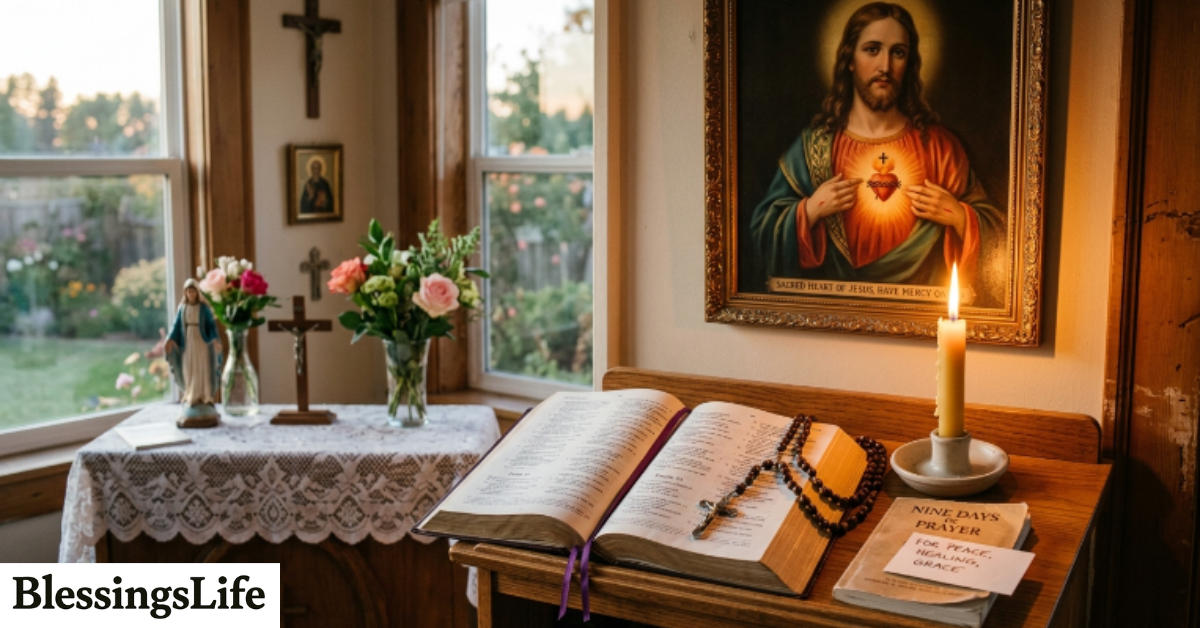
The novena to the Sacred Heart of Jesus focuses on one image in particular: Christ’s heart, often depicted wrapped in thorns, radiant, and open — a symbol of a love so complete it holds nothing back.
Catholics pray this novena for all kinds of reasons:
- Healing for a sick loved one
- Peace in a broken relationship
- Guidance during a major life decision
- Financial hardship
- Conversion of a family member who’s drifted from faith
- Simple gratitude for blessings already received
There’s no “correct” reason to pray it. If your heart is heavy, that’s reason enough.
Where Did This Devotion Come From?
Most devotions have a story behind them, and this one is especially moving.
In the late 1600s, a French nun named St. Margaret Mary Alacoque reported a series of visions of Jesus, in which He revealed His heart as a symbol of His love for humanity — a love, she said, that felt largely unreturned and forgotten.
It sounds almost heartbreakingly human, doesn’t it? Even in the language of these visions, there’s this ache of wanting to be truly seen and loved back.
Out of those visions came what we now call devotion to the Sacred Heart, and eventually, the novena to the Sacred Heart of Jesus took shape as one of the most beloved ways to practice it.
By the 1800s, this devotion had spread across the Catholic world, and Pope Leo XIII would later consecrate the entire human race to the Sacred Heart in 1899 — a sign of just how deeply this simple image of a wounded, loving heart had taken root in people’s lives.
Why People Keep Coming Back to This Prayer

Here’s something a parish priest once told me: “People don’t return to prayers because they’re pretty. They return because something in them answers something in us.”
The novena to the Sacred Heart of Jesus keeps drawing people back for a few honest reasons.
It Doesn’t Ask You to Have It All Figured Out
You don’t need perfect theology or flawless faith to begin. You just need to show up, day after day, and say the words even when you’re not sure you believe them yet. Many people say that’s exactly where their faith started to grow — in the repetition, not before it.
It Gives Grief and Worry Somewhere to Go
When you’re anxious, having a structure — nine days, a specific prayer, a specific focus — gives your mind something steady to hold onto. Instead of worry looping endlessly, it gets directed somewhere.
It Connects You to Something Bigger Than Your Current Crisis
There’s real comfort in knowing millions of people, across hundreds of years, have prayed these same words in their own kitchens, hospital waiting rooms, and quiet bedrooms at 2 a.m.
How to Pray the Novena to the Sacred Heart of Jesus
You don’t need candles, incense, or a perfectly quiet room (though if you have those, wonderful). You need nine days and a willing heart.
Here’s a simple way to structure each day:
- Find a quiet moment — even five minutes works.
- Make the Sign of the Cross and take a breath.
- State your intention silently or aloud — what are you asking for?
- Pray the novena prayer (below), slowly, meaning the words as you say them.
- Sit in silence for a minute or two afterward, just listening.
- Repeat for nine consecutive days.
A Traditional Novena Prayer to the Sacred Heart
O Sacred Heart of Jesus, I place all my trust in You.
In all my needs, in all my trials, I will turn to You and ask for Your guidance and help.
I know, Lord, that You are always working, even when I do not understand.
I believe in Your love for me, even when I feel unworthy of it.
Grant me, through Your Sacred Heart, the grace I need at this time (mention your request).
May Your will, not mine, be done.
Sacred Heart of Jesus, I trust in You.
Amen.
Many people also add a Hail Mary, an Our Father, and a Glory Be at the end of each day’s prayer, though this isn’t required — it’s simply a common tradition passed down through families.
A Story Worth Telling
A woman I’ll call Teresa once shared her experience praying this novena during her husband’s cancer treatment. She wasn’t especially devout before that season of her life — she described herself as a “Christmas and Easter Catholic.”
But sitting in a hospital corridor one night, exhausted and terrified, a nurse who noticed her crying quietly mentioned that she prayed the novena to the Sacred Heart of Jesus for her own family struggles.
Teresa started that same night. Nine days later, her husband’s scans weren’t perfect — but something in her had shifted. She said the fear hadn’t disappeared, but it no longer controlled her the way it had before.
“I didn’t get the miracle I begged for,” she said. “I got something else instead — I stopped feeling alone in the waiting.”
That’s the thing about this devotion. Sometimes the answer isn’t the one you expected. Sometimes it’s peace instead of a cure, clarity instead of a solution, or the strength to keep going one more day.
The Twelve Promises of the Sacred Heart (Quotes & Examples Box)
Part of what makes the novena to the Sacred Heart of Jesus so beloved is a set of assurances traditionally connected to this devotion, known as the Twelve Promises. They’re often shared as a source of comfort and hope for those who practice it faithfully.
🕊️ “I will give peace in their families.”
🕊️ “I will console them in all their difficulties.”
🕊️ “I will be their refuge during life, and above all, in death.”
🕊️ “Sinners shall find in My Heart the source of an infinite ocean of mercy.”
🕊️ “I will bless every place in which an image of My Heart shall be exposed and honored.”
These aren’t magic guarantees — they’re expressions of trust, meant to be held the way you’d hold a loved one’s promise: with hope, not certainty of timing.
Many families keep a small image or plaque of the Sacred Heart in their homes as a quiet, daily reminder of this devotion — not as decoration, but as a kind of ongoing conversation.
Tips to Make Your Novena More Meaningful
A few small things can turn this from a checklist into a genuine experience:
- Keep a journal. Write your intention on day one, then jot a few lines each day. By day nine, you’ll often see your own heart shifting.
- Pray at the same time daily. Consistency helps the prayer sink in rather than feeling rushed.
- Don’t rush the silence at the end. That quiet minute matters as much as the words.
- Invite someone to pray with you. Grief and worry shrink a little when shared.
- Don’t quit if you miss a day. Simply continue — this is a relationship, not a test.
When Should You Pray This Novena?
There’s no single “correct” time, but many people choose to begin:
- On a Friday, since Fridays are traditionally associated with devotion to the Sacred Heart
- Leading up to the Feast of the Sacred Heart (usually in June)
- During a personal crisis, when they need extra strength
- As a New Year’s or birthday tradition, to start a season with intention
Really, the “right” time is whenever your heart tells you it’s time.
A Gentle Word Before You Begin
If you’ve made it this far, chances are something in your life brought you here — worry, grief, longing, or maybe just quiet curiosity. Whatever it is, know this: the novena to the Sacred Heart of Jesus has been prayed by people in every kind of pain imaginable, and it has held space for every kind of hope, too.
You don’t need the perfect words. You don’t need unshakable faith. You just need to begin.
Nine days from now, you may not have every answer you’re hoping for. But you might just find, like Teresa did, that you’re no longer carrying it all alone.
If this guide brought you comfort, consider sharing it with someone who might need it today — sometimes the best gift we can give is simply handing someone a place to put their hope.
FAQs
What is the novena to the Sacred Heart of Jesus for?
It’s traditionally prayed for healing, peace, guidance, or any personal intention, asking for God’s grace through devotion to Christ’s Sacred Heart. Many also pray it simply out of gratitude.
How long does the novena to the Sacred Heart of Jesus take each day?
Just 5 to 10 minutes daily is enough — what matters most is consistency and sincerity, not length. Even a rushed morning can include this prayer.
Can I start the novena on any day, or does it have to begin on a specific date?
You can begin on any day you feel called to start. Many choose Fridays or the days leading up to the Feast of the Sacred Heart, but it’s not required.
What if I miss a day during the nine days?
Simply continue where you left off, or restart if you prefer. God isn’t keeping score — this prayer is about your heart’s effort, not perfection.
Do I need to be Catholic to pray this novena?
While it’s a Catholic devotion, anyone seeking comfort, hope, or connection with God is welcome to pray it with an open and sincere heart.
What are the Twelve Promises of the Sacred Heart?
They’re a traditional set of assurances — like peace in families and comfort in hardship — associated with devotion to the Sacred Heart, meant to inspire trust rather than serve as guarantees.